
Author: silkep@nwci.ie

Op-Ed: Finland’s childcare is state-run, cheap, and plentiful — why can’t Ireland do it?


We feel incredibly privileged to have this excellent system for our kids, and the thought of having to go back to Ireland to try and navigate the system there was a major factor in us choosing to stay in Finland, says Dan Nickström

Published on 29 September in the Irish Examiner 

Six years ago I moved to Finland with my young family. I’m Irish, I have a seven-year-old and a four-year-old, and my older child has been through the childcare systems in both Ireland and in Finland.

Our experience of childcare in the two countries could not be more different.

In Finland, the system is completely public, with the staff all paid by the state, usually on permanent contracts, with holidays, pensions and all the usual entitlements of a good job. Our children have been with the same people for the last four years, and we have a close connection with them.

The facilities are also significantly better than anything I saw in Ireland. The state or local government designs and builds the daycare facilities and the more modern ones quite often cater for more than 100 kids. 

For us, this seems to be a very good thing because scaling up means they have better facilities for everyone. The children are still in small groups with a great ratio of teachers to kids. 

They have kitchens and canteens that make tasty, healthy food on site, they have large gymnasiums that wouldn’t be feasible in a smaller building, and they have huge, well-equipped play yards. These yards double as public playgrounds during evenings and weekends.

Our daughter is in from 8.30am to 4.30pm and care is available 365 days a year at no extra cost. There are even 24-hour daycare centres dotted around the city for children whose parents work nights such as doctors, nurses, or taxi drivers. 

Children get dinner and sleep overnight before being picked up by their parents on their way home from work. This costs exactly the same as a regular daycare.

We had two kids in full-time childcare for several years, and it cost nothing. We recently started paying €50 a month because we crossed the income threshold. But that threshold is very high. 

The family income has to be over €6,000 per month before you start to pay. It’s then capped at a couple of hundred euros for the highest earners. When I think about what friends of mine are shelling out at home, the equivalent of a second mortgage or even more than that, I just can’t imagine the strain.

In Ireland, lots of parents seem unable to access a spot at all. Here, the system is centralised. You apply for your chosen location four months before the date you plan to start, and if you don’t get it you are guaranteed a spot in a nearby daycare.

It’s worth repeating that: every child is guaranteed a place. You might be on a waiting list for your chosen daycare centre, but you will have care in a different daycare nearby while you wait.

The problem isn’t solved once a child goes to school at five years of age. What are parents in Ireland supposed to do when children finish school in the middle of the day? 

In Finland, kids are entitled to full-time daycare until they turn six when they start in “pre-school”, the equivalent of junior infants in Ireland. Pre-school includes after-school care as a standard, in the same building and with the same teachers, so it’s absolutely seamless. 

In pre-school, your kids are still there from 6.30am to 5pm if necessary and it’s an even lower cost than daycare; in fact, it’s free for many parents.

Our seven-year-old is now in the first grade and he cycles himself to school independently, which is encouraged here. His official school day ends at 12.30, but thankfully all schools are mandated to provide after-school care for all first and second graders. 

A group of after-school club workers take over from the teachers and lead the kids with games in the schoolyard and activities indoors. Our boy loves it, he stays until 5pm every day and then he cycles himself home. 

After-school care is free if your income is below €6,000 a month and half price if it’s below €7,500 a month. The full price for people on higher incomes is €120 a month.

We feel incredibly privileged to have this excellent system for our kids, and the thought of having to go back to Ireland to try and navigate the system there was a major factor in us choosing to stay in Finland. 

It is unfair that parents and children in Ireland go through so much stress, uncertainty, and financial hardship for a service that we know can be provided in a much better way.
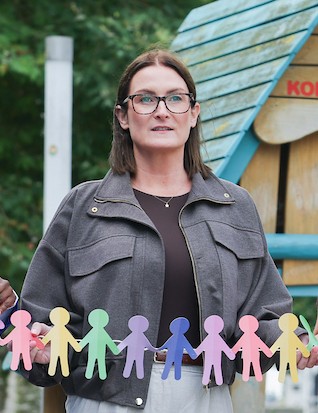

Op-ed: Our children deserve early years education that prioritises their needs over profits

Elaine McQuillan, CEO, StartBright 

Published on 3 September 2026 in the Irish Examiner We have become so used to thinking of childcare as big business in this country that we have forgotten there are many, some quite obvious, solutions to the crisis we are facing.  

 StartBright runs a number of early childhood education and care services across Dublin using the social enterprise model. Operating from a central hub, our organisation turns a small profit which is re-invested into our services, meaning we can provide a standard of excellence to our families without charging astronomical fees.  

 StartBright is also an active member of the Together for Public campaign, composed of an Alliance of 50 organisations calling for Government to provide public childcare, in a model similar to our primary school system.  

 The youngest among us deserve a good education. To us, it seems obvious that market-led early years provisions alone will not provide this for all children.  

 Across Ireland, there are childcare deserts where market-based providers do not deem it profitable enough to establish Early Years centres. These are areas that badly need Government to step in and either provide a fully subsidised service, or to work with service providers like us, who can establish a sustainable centre. 

 The StartBright Social Enterprise model has a particular mission to improve outcomes for children and their parents. Our model places children and their families at our core, not profits or payments to large investors. Because we reinvest any profit gained back into our services, we are continuously improving our facilities, increasing access to services in underserved areas and offering more to the families and children we work with. We can afford to hire staff in roles such as Family Facilitator – a qualified professional that provides one-on-one support to parents and links them to supports in the wider community – and educational leaders who mentor and lead high-quality practice and pedagogy. StartBright builds our services around child and family needs, by offering flexible hours delivers positive outcomes because profit extraction is not our primary driver. 

 The StartBright model is not only better for children and families, but also for staff. Across our sector, recruitment and retention rates among educators are extremely poor, with precarity, low pay, and inconsistent working conditions affecting educators throughout the sector. The educator workforce is overwhelmingly women, adding another layer to the gender inequality rooted in this crisis.  

 At the heart of this early years organisation and the public childcare approach is to offer less administrative burden on workers in their day-to-day workplace schedules, so more time can be given to caring for and educating the children in their services. StartBright offers career progression opportunities and roles in addition to educator roles, supporting staff to feel valued and empowered. 

 Therefore, the social enterprise model can sit comfortably within the public model, and the public model can in turn sit comfortably alongside private provision. The State has the means to acquire buildings, and we have the expertise and capacity to operate out of them, and to scale up our model. I believe our early years settings can operate side by side, and must, in order to realise the right of every child to education and care from birth.  

Public provision can – and should – be piloted in those childcare deserts where families, especially women, are crying out for decent early years education and care. Yes, Government would have to provide capital upfront, but our sustainable model means soon the services would begin to pay for themselves.  

 So, how can Government progress the right of every child to education and care from birth? As proposed in the Roadmap to Public Childcare – the Together for Public position paper published this year – ideally, the State would start by taking on educators’ wages. In order to provide early years educators with the professionalisation and acknowledgement they deserve, this public policy move would be a huge indication of positive shift away from the currently market-led model, bringing us far closer to the Programme for Government commitment of €200 per month per child.  

 The State has existing systems for the wages of primary and secondary school teachers, without their being employed directly by the state, as those in voluntary schools are employed by private boards of management. This system, which allows for standardised pay scales, collective bargaining, and greater job security, would support educators while at the same time removing administrative and cost burdens from providers. This is the wage structure the Together for Public Alliance, and therefore StartBright, encourage and support the State initiating through Budget 2027.  

 In light of this, the State-led Acquisition Programme, into which Minister Foley announced an investment of €135 million is extremely welcome. This, alongside the Building Blocks Extension Scheme, offer tangible programmes for early years services to expand and embrace this social inclusion model; however, they must not be seen at the end point but merely the beginning. State-led and public provision are each respectively necessary to end the childcare crisis and care for children in Ireland. Government must invest in pathways for early years education and care, and take a direct, active, and enthusiastic role in providing it.  

 We can no longer view childcare as a luxury offered by market-led providers to people in well-off areas with generous salaries. Quality early years education is a public good, with huge knock-on effects for women’s equality as well as children’s wellbeing. Children’s rights, children’s equality, and children’s individual development must be at the heart of any future reforms to Ireland’s early years system.  

Op-ed: The lack of options meant I had to turn down my dream job

Amy Greer Murphy, freelance social researcher and mother of four.

Published on 10 June 2026 in the Journal 

CHILDMINDERS, CRÈCHES, THREE hours a day ECCE places, au pairs, after-school care…

It’s a mind-boggling juggling act trying to find childcare that meets the needs of my family where I live.

I have been a parent for almost a decade, and I am a mother of four. I am perpetually looking for jobs that suit my situation, pay enough to cover the costs associated with leaving my children and household for someone else to manage Monday to Friday, and are flexible enough that we can all thrive.

This has not been possible, save for short contract work to keep my CV up to date. But even short-term contract work is no longer practical or cost-effective since my fourth child came along.

A couple of years back, I was offered my dream job. But after much to-ing and fro-ing, I had to turn it down because it simply wouldn’t have been worth the cost of the childcare. That’s a devastating experience, and one that I suspect happens to women much more regularly than it does to men.

Blocking opportunities for all

And it’s not just my career that is affected. I am very active in my local community – I sit on committees for community groups and volunteer as much as time will allow. But it’s not easy to do without childcare.

I play music and regularly have to skip practice or performance opportunities because I don’t have childcare. Even spending time with friends is complicated, and often I end up bringing my kids along.

Many parents rely on expensive full-time crèches, after-school clubs and willing grandparents offering their time and energy. My family cannot call on a grandparent, and there are no crèche places locally. We had a live-in au pair before our third child was born, but we have long since run out of room in our house for another adult. The opportunity to purchase a larger home won’t be open to us without a dual income.

In short, it’s all so deeply, deeply frustrating.

Last year, our local preschool faced a risk of reducing its hours, meaning my son would have had a partial preschool experience. There is always worry among parents when childcare facilities like this close or put up prices. Inevitably, it is women who end up having to take career breaks, or holidays, or unpaid leave to bridge these gaps.

Losing career opportunities

In my professional life, I have had the opportunity to work on unionising with the early years sector, where I co-authored reports on pay and conditions that badly need improving. Despite lots of positive attention for the plight of professionals within the childcare sector, it remains underfunded, fragmented, and its services are geographically unequal.

While the government has made a substantial commitment to improving the sector, including increases in budget allocation, the situation is that Ireland spends just 0.2% of GDP on Early Years – the OECD average is 0.9%. We fall far behind other advanced nations in funding and providing Early Years Education and Care that is high-quality, affordable and widely available.

In 2024, I joined the Together for Public Alliance, which is a group of over 40 organisations and more individuals who want to see the government establish a public model of childcare. I made the decision to share my story then, in the hope that hearing from parents like me would make a difference to the government decision. I said then that in all my years as a parent, the struggle to find suitable childcare has been the most difficult. Over two years later, nothing seems to have changed.

What hope is there for women in the workplace now, promised during our school days that our third level educations would pay off? That if we worked hard, we would be able to have a home, a rewarding career and a family? For me personally, all I can do is wait a few more years for my children to grow a little more and need less intensive care. But is that really it? I can give up the advocacy at that stage – but is that really the point?

We can do better

We need a system that is built on fairness and equity. We need the government to seriously commit to funding, staffing, resourcing and providing physical infrastructure for Early Childhood Education and Care in a meaningful and timely manner.

A public model of childcare would guarantee a place for every child through legislation, starting from whenever the parents need it and including school-aged childcare. It would be not-for-profit, with all investment directly benefiting children’s education and care.

It would be accessible and available to all children, including children with additional needs, children living in rural areas and children in disadvantaged areas.

It would ensure decent pay and working conditions for early years educators. It would provide flexibility and choice for parents, and would allow women in particular to fully participate in society.

Without it, I might still be waiting for this when my grandchildren are born.